Saturday, May 14, 2016

Tico Farmers...5/14/16

     Although, I would stray far from calling myself a coffee drinker, I will say my appreciation for coffee and the people who play a part in growing coffee have increased. Today we visited Life Monteverde, a local farm here.


It's been an extremely amazing place, definitely my favorite visit by far. The farm not only strives to create sustainability within, but outside as well.  They mentioned that while they take water from the river, they want to make sure it leaves Monteverde Life cleaner than it came in. They also use various sources of energy to help the farm function. For example, they have two pigs that produce Methane Gas used to power their kitchen for 3-4 hours via a biodigester.


Using Lily Water plants to filter 
stream water

What made the farm even greater though, were the people that worked there. Most of the farmers come from Nicaragua to seek better opportunities.  At Life Monteverde, the farmers make a $1.75 per basket of coffee they pick compared to an hourly average minimum wage rate of $1.82 in Costa Rica ( http://costarica.com/business/salary/ ). Rates that are much better when compared to that of Nicaragua. Personally, I still think these rates are low. I would advise the farmer to never settle for less than he/she believes he/she deserves. Don't be tricked when the situation looks better. It is still important to advocate for your own rights and desires. 
     Despite my beliefs, the farmers seem happy with their wages. One of the farmers talked about how being in Costa Rica is helping him grow his own passions and brand, he talked about having a farm of his own in Nicaragua and being able to take what he has learned and apply it over there. 
     The average farmer picks 8-9 baskets a day, however some of the farmers at Life Monteverde can pick upwards of 10-12 baskets a day. One thing that can be a strain is the fact that they only get to see their families 4 to 5 times a year, but at the end of the day everything they do is for their families. 


     Monteverde has been good to me! I bid you adieu, thanks for teaching me a lifetime of history.

The Cloud Forest...5/13/16

     Let's get one thing straight, Monteverde is gorgeous. Today, we got to visit one of Monteverde's main attractions, the Cloud Forest. The Cloud Forest is home to a variety of plant, insect ('o'), bird and mammal  species'. 


Hiking trail in Cloud Forest

     Foreigners have had a huge influence on the Monteverde Cloud Forest and its' surrounding areas. In fact the economy of Monteverde is largely based on tourism and agriculture. Tourism is relatively new to Monteverde.  As we rove through Monteverde I saw a lot of signs advertising coffee tours and tours of the area. It also seemed like Monteverde catered more to tourists, not only at the hotel, but in town as well. At hotel El Establo they had english witten next to each of their selections of the menu in the restaurant and at the Souvenir shop in town the prices were mostly in dollars.
     The cloud forest has been in Monteverde forever, but it was the Quakers whom played a big role in its' preservation. A lot of homesteaders (individuals already present in Monteverde) wanted to cut down some of the land and use it for their own uses, but the Quakers sort of brought them out of this deal. Another fact that I learned during the tour was that one of the Quakers had found a unique species of frog, called the Red Golden Frog at a time when the Monteverde Cloud Forest was just a forest. The Quaker ended up sending the frog to a researcher who was so amazed and in awe by the fact that he had never seen one before that he declared that the area needed to be immediately taped off and preserved.

     Unfortunately we didn't get to hear the Quaker presentation, however our Cloud Forest tour guide, Ricardo, whose parents happened to be Quakers had a lot of valuable information to share. It's important to note that the Quakers played a prominent role. Most of them, who had come from Alabama, USA had already had previous experience in dealing with crops. So when they came to Monteverde they already knew how to work the land.


Friday, May 13, 2016

The other side. The other side. The other side of...5/12/16

Hey!

     I am currently in Monteverde, which I might add is 10x more beautiful than San Jose. We got here yesterday after a 4 hour bus ride. The weather is all over the place! It's usually pretty warm/hot in the morning/afternoons and then rainy in the evening. Yesterday, it misted a lot randomly, but to be honest this is just my type of weather. 


Hotel El Establo, the resort 
we are staying at
(rainbow not necessarily included)

     There was definitely a lot to look at on the drive here. One thing that was noticeable was the general increase in the amount of trash on streets. Before we left Pittsburgh, we found out that Costa Ricans generally didn't care for the cleanliness of their streets, which I instantly thought was a lie when we were in San Jose, but as we traveled further out of San Jose I could tell that  this certainly was the case. 
     Despite the trash, I have been in complete awe since I've been here. Everything is so green and the sky is so blue.


Driving through, I also noticed that most of the homes were similar to San Jose homes, they just gave off more of a "beachy" vibe, and they were at times more hidden (but I'm sure this is due to the fact that we were on the highway). I also noticed that there were more street vendors as we drove through. It made me wonder if there were no local markets in their area or if they just saw it more profitable to sell food and fruits to people traveling along through the highway. There are way more tourists here. Even the souvenir shops cater to American dollars. We also saw another study abroad program, so that was interesting!
     My expectations have been exceeded. I definitely expected the sights to be better than those of San Jose and this is the case. Everything is just  a whole lot more peaceful. 

Wednesday, May 11, 2016

Put some (respeck)t...ech on it...5/11/16

     Today's visit to the Universidad Verita's FabLab, the University of Veritas' tech  and makerspace got me thinking about how exactly technology could be applied to the coffee industry and if these applications would be truly beneficial.


Universidad Veritas FabLab

     The addition of different types of technology to coffee industry would all have different effects, some positive and some negative. For example, drone technology would be able to be utilized as a delivery system. Entrepreneurs in Amsterdam have been working on a drone called the Coffee Copter that would delivery a fresh cup of coffee of the customers choice to the customer with the tap of a finger on an app. This virtually allows the consumer to grab a cup of coffee without hindrance from his/her current duties. A variety of things could be changed utilizing 3D printing in the coffee industry. Probably the best being that it could help with packaging, or components of a package. For instance, at Cafe Britt, the bag was designed with aluminum foil on the inside however there was a plastic piece on the bag that was there to ensure that no oxygen got into the coffee. It would be much cheaper to make these plastic pieces using 3D printers because it is an additive process, so no material would be getting wasted along the way, or perhaps an entirely new design could be created using 3D printing alone.
     A spot in which automation could be used, is at coffee farms. In order for coffee beans to dry they need to be placed in the ground and raked every hour during sunlight. Having technology designed to complete this task, would take away some of the responsibility and tediousness on the workers part. However, this technology could also take a lot of jobs away. 
     In terms of picking coffee beans, I believe it is best if this is done traditionally. A coffee bean is not ripe unless it is red, and usually buyers select the type of coffee bean they would like. It's fair to assume that it would take an immediately long time before any machine would be able to precisely pick what bean is good and what is not. This is most fundamentally human knowledge.


Tuesday, May 10, 2016

Adapt Ourselves to Expand Ourselves...5/10/16

      You can't dislike what you don't understand! I mean you can, and you can when you understand it, but you find a new appreciation for the chunche (thingamajig), maybe your heart even warms up a little. I dislike coffee and I still do, but it's cool to know how exactly the bean that is made gives so many people a jump start to their day. Today, I had the pleasure of visiting Cafe Britt, and thanks to our awesome tour guides it was a great experience.

At Cafe Britt, Julio and Carmen brought out 
their "comedic" personalities. 


          For the most part, Cafe Britt sells coffee and chocolate in their shops, most of the coffee is bought from coffee farmers, and it is interesting to note that Cafe Britt sells more chocolate than coffee. Cafe Britt just does the roasting and packaging, so in this sense it is both a retailer and a manufacturer. On the other hand, Cafe Britt supplies these coffee and chocolates to Britt Shops, a store of the company. So in this regard, Cafe Britt would be a supplier. 

Cafe Britt only has one coffee plantation in Heredia, Costa Rica.
They get the majority of their coffee from coffee farmers!
Pictured here is where they roast and package the beans.
          Cafe Britt's success comes from its' commitment to providing customers with fresh coffee. However, in order to provide customers with coffee they must have the coffee beans themselves. They must carefully negotiate and create contracts with coffee farmers they believe have good coffee beans. Cafe Britt  has only one coffee bean plantation, so they consider themselves mostly "Roasters not farmers". Having a reliable source of coffee beans is important to Cafe Britt's business because it is basically its' foundation.  Cafe Britt also takes heed to its' customer feedback. They even have a department set up for customer service. Despite the situation, Cafe Britt will always reimburse an unhappy customer. This is significant because a lot of people buying goods at Cafe Britt shops are in turn buying them as a souvenir or gifts. It's important to show your customers that you care about their opinions and are thankful that you have invested in them. The best way to do this is through customer service. All in all, Byron Mora, the Operations Manager for Costa Rica and the Caribbean has stated that in our to expand the company it must be able to adapt. That is a great philosophy to have because what works in one country doesn't necessarily work in all countries.

           I was surprised to hear that Cafe Britt did not appeal to most Ticos, and I think this is what's hurting them the most. Most Ticos don't drink Cafe Britt because they can't afford it, and I feel like this is a similar situation in other countries that Cafe Britt is present in such as Nicaragua, or Peru. You can't have a fully successful business when the people in your community don't even have the opportunity to support your product and vouch for it. I do like how they make souvenirs specific to the countries in which they are located instead of just generic souvenirs, however I think it'd be great if they branched out of appealing to tourists so much. Financially, it seems like they are prospering, but aesthetically it's a different story. In this case, it seems like the two can't go together unless Cafe Britt were to do some re-branding, but right now they seem fine as is.


Monday, May 9, 2016

This Street Thing ...5/9/2016

Pura Vida! 

Usually street names play a huge role in helping people get around a city, they give us a sense of direction in the most simplest way possible, at least if we have a GPS. Well, guess what? Costa Rica doesn't play the name game if you catch my drift. 

Ok, I lied, they play the name game slightly. The major streets have names. Avenue 0 is the central street and then all of the streets parallel to it are also Avenues however they have different ascending numbers. Streets north of Avenue 0 are odd avenues and streets south of Avenue 0 are even Avenues. So, the second street south of Avenue 0 would be Avenue 2. The streets perpendicular to Avenues are called Calles which literally translates to "streets". Calles follow the same rule as Avenues except for the fact that odd Calles are now east of  Calle 0 and even Calles are west. Avenue 0 is just a block or two away from the National Theatre of Costa Rica. While these names do exist, Costa Rica lacks in entirety street addresses. A persons address in Costa Rica is directly related to what they are located around. There are no numbers and street names. For example, an address here could be 

20 meters North of Soda Barrito
Right at Old University
Walk 2 blocks

I can only assume that Ticos ( nickname for Costa Ricans) are used to the lack of street addresses. I personally think it forces them to go out more and get to know their city, especially if their job consists of making deliveries to restaurants. Ticos should only take delivery jobs if they know there way around because they've grown up knowing the way their street addresses are set up. In that sense I don't think street signs matter as much as people may think it does. At the end of the day you're going to get to where you need to be so long as you have a sense of direction, now I can't say how much time it would take for both, but as far as I've seen, there doesn't really seem to be a difference. Ticos are accustomed to the way their streets are set up because the streets belong to them. Of course a foreigner isn't going to have the same experience, but it isn't anything too much to be worried about.

The idea of no street addresses to a foreigner  could be overwhelming depending on what country they are coming from, but to me I'm feeling alright about the whole situation. My parents weren't too big on the whole GPS thing when I was younger. It was all about following behind friends cars when going to a destination we weren't sure of, or talking your way there, receiving instructions as to what you should do until you reached a pinpoint location and repeating the process until you had reached your destination!  So at the moment I'm not too overwhelmed about the lack of street addresses, but who knows? As I venture out to explore the city more, I'm sure I'll have a couple of moments of confusion, but it'll definitely be an experience I'll grow to appreciate!

76 and its' transition to culture...5/8/2016


GATE 76

Gate 76 directly translates to a lesson in culture. Here we took a flight from Pittsburgh to Atlanta, with a 7 hour layover, we then boarded the plane to Costa Rica for a 4 hour flight! After going through the process of customs and immigration we were eventually united with our host families, pretty late in the night I might add. It’s turning out to be a completely interesting and great experience! However, back to the topic at hand, “…and its’ transition to culture.” Official day 1 (as I’ve deemed it), has been completely amazing. The day started off with a breakfast filled with papaya, cornflakes, a sandwich, and some juice. The papaya is by far better than the ones in the US, and that’s saying a lot for someone who previously did not like.
                Breakfast was followed by a walk to the San Jose ISA (International Study Abroad) office. Of which Ania, the program coordinator, gave us advice and a rundown on some of the basic facts and ways in which Costa Rica functions. Afterwards we went on both a bus and walking tour of San Jose, and gained a lot of the history behind the city.  One of the first things we saw was the University of Costa Rica, founded by Rafael Angel Guardia Calderon as we had previously discussed.


Universidad de Costa Rica

What I found interesting was the fact that public colleges are harder to get into than a private college, thus mostly students that were privileged and came from private high schools got into public universities.

                It’s still very evident that Costa Ricans are proud. We visited a park that had an interesting statue pictured below:

Previous to 1854, William Walker, an American from Tenessee, had gained control over Nicaragua. He wanted to see slavery through to Costa Rica, and of course there were several people who disliked this. The war lasted two years, and this statue is representative of it. There are 5 women there that represent the 5 countries of South America and one is a sort of covered women that represents William Walkers rule over Nicaragua. The woman with the flag (Costa Rica) is guiding the countries towards liberty, with the fallen man being William Walker. Costa Rican pride is not only present in its' statues. The people are very prideful and friendly as well.

Unfortunately, this post is getting slightly long, but there's so much more! Here's a few snapshots from the days:


View of downtown Costa Rica


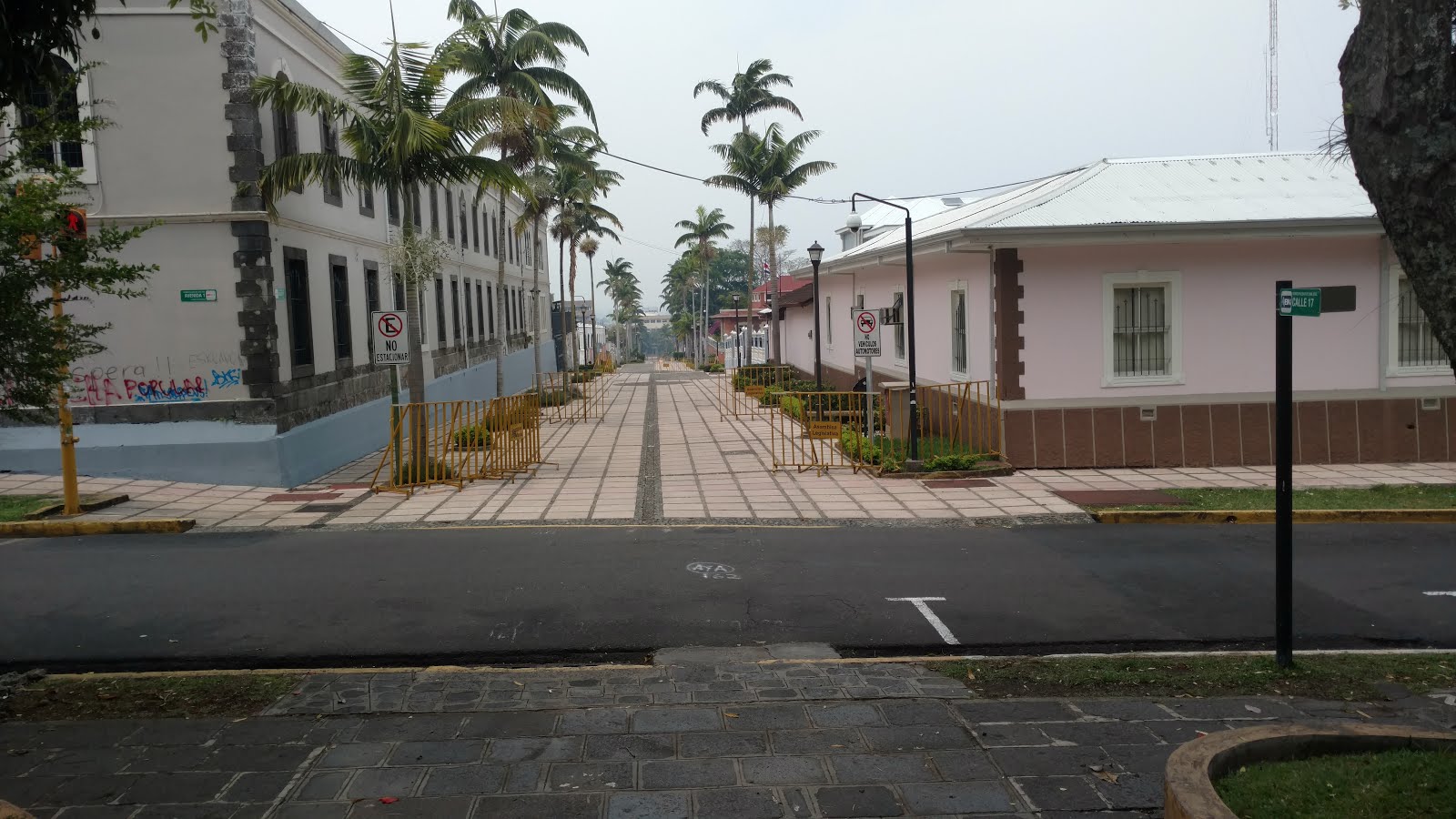
               Legislative Branch of Costa Rica

Congress is comprised of 59 senators. These senators are tasked with providing efficient and helpful laws for the public. Some individuals publicly express their opinions on the government by putting graffiti on the buildings.


Casado!!

Food wise, a Casado is a marriage of food, or a bunch of different portions mixed together to form a meal. Trust me, the food was great!


Only day one, and the experience has been amazing! See you tomorrow!!!